

(45) A system of interconnected RCs
By Onno Hansen-Staszyński | Last Updated: 23 May 2025
The first step in setting up Resilience Councils to address FIMI is to establish an institution that brings together all organisations already active on the supply side of FIMI, such as fact-checkers and researchers. These organisations detect, analyse, and evaluate FIMI incidents and campaigns that might otherwise go unnoticed. Gathering their representatives in a single Resilience Council not only democratizes the handling of FIMI but also creates an opportunity to standardize a currently fragmented field. By opening communication channels and fostering cooperation among them, it becomes possible to introduce common standards, both conceptual and technological, for describing, classifying, and grading FIMI incidents and campaigns.
Limitations
However, this first step alone is not enough to truly democratize the response to FIMI.
First, neither academics nor NGOs represent society as a whole. This is obvious for academics, but it might seem less intuitive for NGOs, as they are often seen as pursuing the common good. Yet NGOs usually focus on specific aspects of the common good, not the entirety of it. Their specialised missions make them valuable sources of knowledge and insight, but also align them with the characteristics of interest groups: they promote their own agendas and seek increased funding and visibility.
Second, because academics and specialised NGOs focus on detecting, analysing, and evaluating FIMI incidents and campaigns, they largely operate within the domain of “fact-speaking.” While they may also study the impact of FIMI on the broader public, they do not represent the general population’s perspectives. In their work, the potential demand-side of FIMI, how and why people absorb or reject information, is more an object of study than an active stakeholder.
Therefore, to complete the structure, two additional types of Resilience Councils must be established alongside the initial one formed by academics and NGOs: Resilience Councils for “belief-speakers”, and a Common good Resilience Council.
RCs for “belief-speakers”
Belief-speaking, as discussed multiple times on this blog (see, for instance: blog post nineteen), should be an integral part of any productive democratic debate. It adds a crucial layer of meaning to “facts”: what do these facts mean to us? Belief-speaking is not about denying or questioning facts but about determining the place facts should occupy in public debate, and what responses they call for.
Distilling sense from a wide range of opinions is not easy, especially in times of affective polarization and social fragmentation. Fortunately, as outlined in blog post twenty-seven, it is possible to extract collective wisdom even under these conditions. For a “belief-speaking” Resilience Council to function effectively, several preconditions must be met: individuals must have at least some information about the subject; their opinions must be diverse, drawing on a range of local experiences; and they must formulate their views independently, without being influenced by others.
The last precondition, independent formulation, is the most challenging. In practice, it means that individuals must express their views spontaneously, without prior discussion or exposure to others’ opinions. In our school pilot, this translates into students receiving a question and answering it individually and in silence (see: blog post forty-one). This requirement makes it necessary for all participants to respond to the same question at the same time, in a setting that completely blocks communication and external influence.
Concrete steps
Organizing such “belief-speaking” conditions for a small group seems feasible. However, the real strength of belief-speaking lies in avoiding reliance on representativity, which could otherwise trigger feelings of exclusion and mistrust. The aim should be to involve all citizens. Although this presents a major logistical challenge, especially on a sensitive topic like FIMI, it is important to make the attempt.
My proposal is to start by engaging groups that can easily be assembled under controlled conditions, such as adolescent students. The next step would be to involve groups that have a strong intrinsic motivation to participate, such as self-help groups or interest groups. Their internal drive should be strong enough to meet the strict requirements of belief-speaking. Step by step, ever more citizens could be drawn into the process.
Naturally, not every small or large group would constitute its own Resilience Council. Instead, an overarching RC could be created per group type, for example, one for adolescent students, one for medical patients, and one for sole proprietorship owners. Participants would meet under the prescribed conditions, and their individual answers would be collected on a central server. AI would then summarize the results: detecting patterns, clustering responses, identifying outliers, aggregating conclusions, performing sentiment analysis, and conducting quality control. A draft report would be prepared and sent to the relevant RC, which would formulate recommendations based on it and share these with the participants. The participants would then provide feedback, again individually and independently, after which the RC would issue its final recommendations.
Common good RC
The final type of Resilience Council needed is a common good Resilience Council. Its role is to integrate the fact-speaking outputs and belief-speaking recommendations to serve the broader common good.
To avoid the limitations seen in the academic and NGO Resilience Councils, the common good RC should not be composed of institutional representatives. Instead, it should be made up of fiercely independent individuals. These individuals are not necessarily neutral belief-wise, but their stances should not be too controversial. What matters most is that their dedication to the common good is beyond dispute.
At this stage, I have no clear examples of individuals who would fully match this description. For now, this remains a normative outline.
Cooperation between RC types
In my view, the first step in addressing FIMI through the different types of Resilience Councils is to begin with detection, either by a “fact-speaking” RC (academics and NGOs) or by a “belief-speaking” RC. Once a relevant incident or pattern is identified, the detecting RC drafts a recommendation and forwards it as an alert to the common good RC.
The common good RC then takes the next step: if the alert came from a “belief-speaking” RC, it requests a factual report from the relevant “fact-speaking” RCs; if the alert came from a “fact-speaking” RC, it asks the appropriate “belief-speaking” RCs for a belief-oriented reflection. Finally, based on all input received, the common good RC drafts a set of recommendations. If the situation is not time-sensitive, these draft recommendations are sent back to both “fact-speaking” and “belief-speaking” RCs for reflection and feedback before finalization.
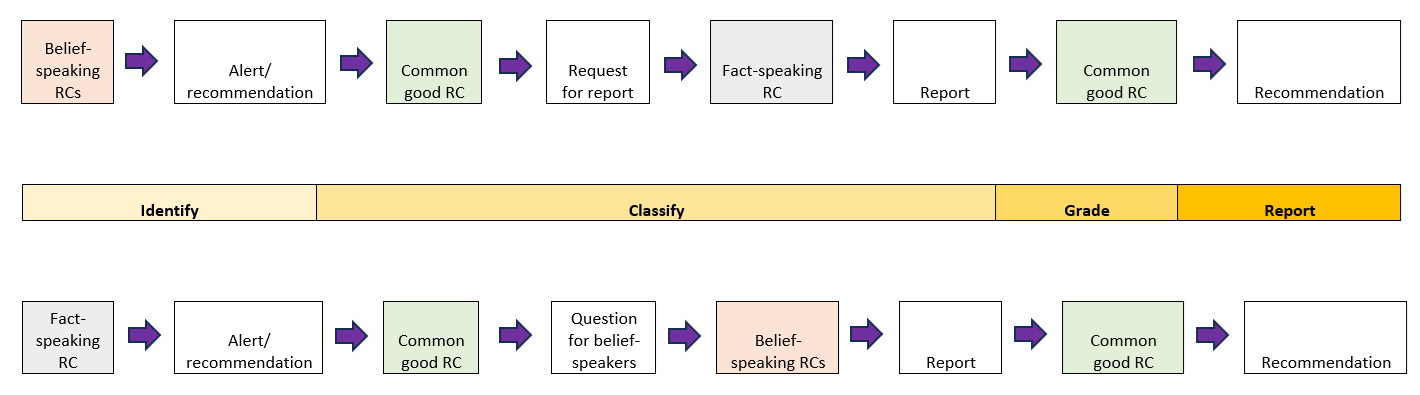
By implementing this system of interconnected RCs, an all-society approach to dealing with FIMI will be established. The next major challenge is to define how the process should continue after the common good RC issues its recommendations.
International
The description above concerns a national RC system. On an international level, I could envision an Advisory Board supporting national RCs, a European RC in which representatives of national RCs take place, a common digital infrastructure (including a dissemination platform) to facilitate standardization and interoperability, common education modules (EMoD - see: blog post twenty), and, optionally, a rapid response system.
Subscribe now &
Get the latest updates
Subscribe